Showing posts with label attention. Show all posts

Wednesday, 23 January 2013

Helpers, Healers, and Guides

It has always been true that, in seeking guidance, the many have depended on the few. In every time, in every place, there is always a "creative minority" to whom others turn for leadership, for guidance, for courage, for understanding, for beauty. These few who guide stand before the many, not as the ideal bearers of final truths, but simply as the most extraordinarily human members of the community.
The world's oldest profession is that of the shaman or first professional, the shaman is ancestor not only to both the modern medicine man or doctor and the religion is priest or divine, but also ancestor in direct lineage to a host of other professional types. It would seem odd that both the doctor, the most secular-minded, and the divine, the most sacred-minded of modern helpers of people, should derive from the same source. But we can readily understand the seeming paradox when we recognize the basic nature and function of the primitive medicine man of shaman.

The origin of Showmen are found in the shaman. The shaman was the first incarnation of the One Who Faces the Other Way. In these early prehistoric times men, and no doubt woman too, discovered the true power of shared attention. In developing and studying shared attention we as a species became who we are. The preoccupation eventually hard wired us for culture.

Showmanship: more than 'Mere entertainment' - a power to Change

That something "more" which is created in the interaction between a group, led by One Who Faces the Other Way, is a strange power. It is an example of something from nothing. Creatio ex nihil. A whole that become greater than the sum of its parts. All of this "extra" comes through process. Like when wood is ignited, an astounding amount of energy in the form of heat is released. In reality the heat does not come from nowhere, but looking at wood you would not believe such great energy could be released.
When the Showman masters the mere Attention grabbing aspects of addressing a group he can begin to grasp the deeper and more potent aspects of his Craft. As he steps beyond the how-to and technical sides of addressing the many a new and more potent level than 'mere entertainment' appears. 
 If tuned in certain ways this power can be used for healing purposes. In medical terms this power has been called placebo. It is the strange and elusive effect which gives as many as 1/3 patients relief from symptoms. {American Cancer Society.} In the past this tool was often the only thing that could be used in healing a particular sickness. I believe that as we get a better grasp on what the placebo effect is we will find that all alternative modalities tap into it in some way. Modern medicine have, for ethical reasons, a very limited use of placebo. I can imagine litigious patients should be able to make a case against a hospital if they were given homeopathic sugar pills. There is something inherrently dubious in giving someone nothing for their pain and then saying you gave them medicine and on top of it charging them as if you had administered some kind of active ingredient.

Psychic surgery.
The placebo effect is still relied upon in pentecostal and other religious settings. When a group gets together led by a Master Showman be it in the guise of a Filipino psychic surgeon, a revivalist preacher, an acupuncture or general healer including today's doctors this power can be harnessed and used to the sick's benefit. The truth is that individuals does receive benefits from these sessions. But in case of serious illness one should not rely on Showmen of the entertaining or religious/new age kind.
With the advance of science based medicine we have outgrown most uses of performance rituals to heal our pathological illnesses. Although much research is currently being done and more is needed to establish exactly what the mechanisms are for this effect. When it comes to the types of illnesses treated by today's psychologists there can still be found a use for the Craft of the Showman.

The Showman's ancestor's task was to make occasions special. Not in the way of modern day when we Showmen appear in jaunty hats at children's parties, but to make a passage from one phase of life to the next. Birth, sexual maturation, becoming a hunter, a woman, a man, or in death, in victory and triumph as well as in defeat and loss of face the many (the Crowd), needs to stand together facing someone who can channel their attention and guide them. The One Facing the Other Way creates gravitas, he makes the occasion something more. Words will be spoken, songs will be sung, there might be dance, there might be tricks and magical appearances but most importantly the One must make the Many feel. Feel as one, and feel the experience. The hearts of the Many must be caressed and kindled hope of dreams fulfilled, of healing, of certainty in the face of chaos. The One is a light in the darkness of a cave shining as bright as any flame. 
Perhaps that is why so many feels it natural to include a Showman, in the form of magicians, jugglers, comedians, and musicians in their celebrations. They know that they belong, we know that we belong, but most have forgotten why. In the deep recesses of our neolithic minds we have the feeling that the fire we feel thumping in our chests does not belong in the corner entertaining the children, it belongs at the center stage, leading the Crowd.

This power speaks directly to our hearts and creates a loophole in the worlds organization. It is the trickster and the leader, the chosen one who against all odds pulls the sword from the stone the one who might become a charismatic leader. (The following is an excerpt from Sheldon B Kopp's book Guru.)

Charismatic Leaders

Among the best of the helpers, the healers, and the guides are those who can be described as "charismatic." To have charisma is to possess the gift of grace. The Greek origin of the word lelates to the Graces of mythology, those lovely godesses of talent who brought joy, brilliance, and beauty into the lives of men.
It is not enough then that a Guru be a gifted magician. His talents must not be used merely as a celebration of his powers, no matter how remarkable. His gifts  fin meaning only when they are used in the service of offering an opportunity to another. 
Max Weber introduced a sociological meaning to the concept when he developed his "value-neutral" image of such extraordinary men. He delineated three bases for the authority underlying leadership in a community. These included Traditional, characterized by "patriarchal... domination"; Bureucratic, a legalistic defining of authority; and finally Charismatic.
Charismatic leadership always stands over against the other two bases, as it is "strange to all rule and tradition." The charismatic leader comes to power as one to whom others submit because of their belief in his extraordinary personal gifts. He may be a prophet, a shaman, a magical sorcerer, or even a leader of hunting expeditions. His followers are committed to belief in his having qualities far beyond those of other men, qualities that in the past were valued as being supernatural.
It does not matter whether these extraordinary personal qualities of the charismatic leader are actual, alleged or presumed. Such a leader arises when the people need him, at a time when the old order is to be challenged, when he has reason to stand in opposition to the traditional powers.
Perhaps each in his own way can help to free the people whom he guides.
It is, indeed, the guru's own freedom that inspires others to be free and may point the way. One of the sources of charisma has been described as lying in "the apparent unpredictability of the leader's behavior and his seeming indifference to the most awesome obstacles and dangers. THis combination of unpredictable arbitrariness with naive fearlessness is very similar to the innocent spontaneity of the child...
...[T]he central quality in this spontaneity is that such a man trusts himself. It is not so much that he is responding i ways which are beyond other men (or lesser therapists). Rather it seems that he is past worrying about how he is doing. No longer expecting to be unafraid or certain or perfect, he gives himself over to being just as he is at the moment. He accepts his fear, lives with his uncertainty, finds his imperfection sufficient.
Unconcerned with being more than he is at any iven moment and satisfied to be able to do what he can, he is able to do far more than he could if he were still distracted by the question of how well he was doing. Of course, disciples of such a gifted guru will at first be awed by the difference between his seeming confidence and poiwer, on the one hand, and their own helplessness and inadequacy, on the other. The guru then tries to help his follower to see that there is no differnce between them, except as the follwer diminishes himself to give the power to the guru. THe follower maintains the imbalance to avoid the awful reponsibility of being equal to everyone else in the world and completely on his own, while retaining the hope that the guru will take care of him. To maintain his own freedom, the guru must try to free the disciple from himself.
...
Of course, any form of personal power is subject to abuse. The trust of others is a responsibility just because there is a temptation to exploit it. Some gurus are corrupt, and those that are not may become corrupt. In time any form of help that works, ultimately does become corrupt. Each type of guru can only be effective for a time whitin a given setting. The success of every kind of gifted guru inevitably contains within it the seeds of its own failure.
Yet, nothing else lasts. Why, then, should we expect more of those to whom we turn for guidance than we are capable of ourselves? In this ambiguous world, made up as it is of moments, fragments, bits and pieces, we must learn to take love where we find it. And then we must learn to grieve its passing so that we may make room for the next moment.

   
Sheldon B Kopp


Tuesday, 3 April 2012

The One Who Faces The Other Way

The faithful readers of this web publication will know that lately I have been taking an interest in who the showman is? Our role; what is it, and where did it come from? Not an unreasonable question for those of us who have made the showman's Craft our Vocation. Without a firm foundation even the acrobats fall down.
In this article I will take a deeper look at - The One Who Faces the Other Way - (Described in our manifesto.)

Sociality
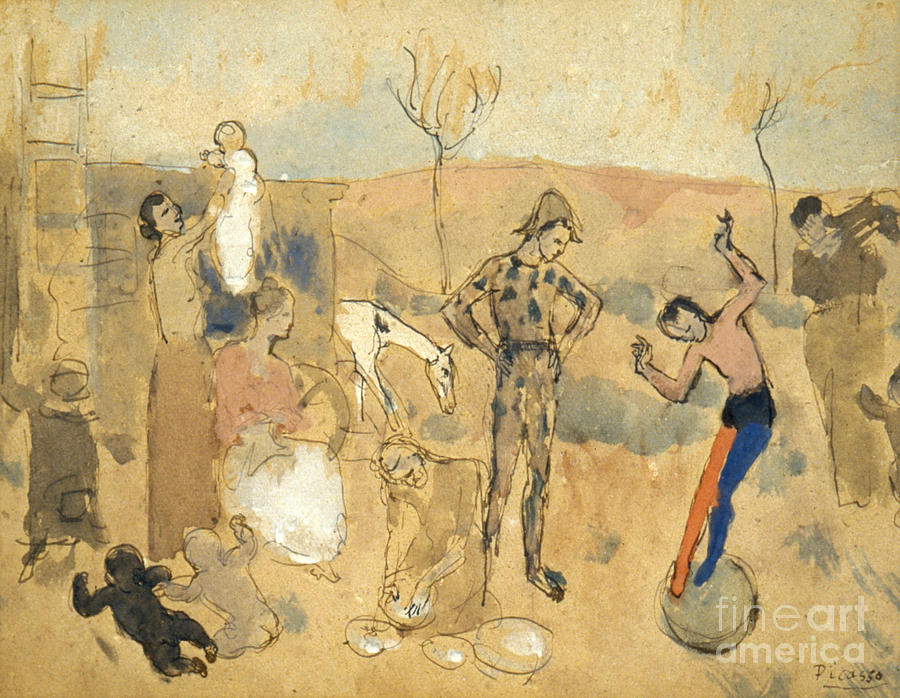
Picasso: Circus Family, 1905.
We are a social species, we need others to thrive, both for our well-being and our survival. Because this is so important, nature guides us towards it with rewards of good feelings. We feel good in others' company. Song and dance rouse our emotions, like nothing else, the production of opiates to bring about states of elation and euphoria.
Our biology guides us with pleasure. Sex feels real good because it is so important. Making the important things pleasurable and enjoyable so you will want to do it is nature's guide. It is where we learn whats important. Human rights are based on human need. The rewarding feelings we have when we share each other's company is your body telling you it's good for you, and therefor an important subject for attention.

Attention
An important part of what makes us human and what helped forge our social bonds is our ability to direct attention. Sharing attention by giving and taking mental focus is key to the social process. We crave getting and giving attention. It is as important as oxygen and nutrition for us. In this process we humans far surpass any other animal in our desire and ability to maintain focused attention for very long periods of time. By sharing attention we transmit meaning, tell story, laugh, and fall in love, all our most human aspects. 

When we share attention we face each other. We direct our gaze towards those we engage with.
Face to face. One sharing thoughts, ideas and emotions with the other. From each other's faces we can easily read and unconsciously interpret so much subtle information.
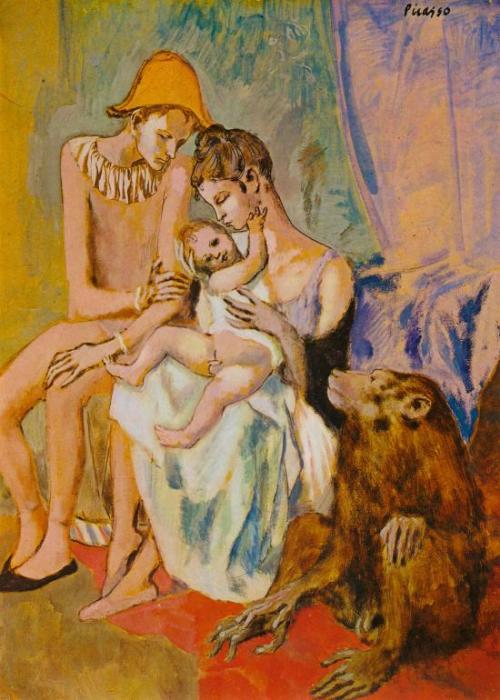
Harlequin’s Family With an Ape (1905)
Directing attention can be done in many ways, with hand gestures or simply with the eyes. The ability to use our eyes has been so important that evolution has shaped the way our eyes look to make them better suited to the task. The iris and pupil being dark against the white of our eyes makes it very easy to spot exactly what the person is looking at. This kind of adaption is to be expected since we are such a visually oriented species. Apes are also social but the fact that our eyes changed since we split off on our journey towards becoming a separate species, gives us a clue to the further importance sociability had for us.
We are the species with the most complex and advanced sociality. Other species like bees, ants, sheep, chimpanzees and praerie dogs all show different aspects of social behavior, but none are as varied and, most importantly, as adaptable as us. Some biologists calls us an "ultrasocial species".
Primatologist Michael Chance recognized that subordinates pay disproportionate attention to dominants, glancing at them far more than the dominants at the subordinates, and proposed that the social organization of attention has been a crucial factor in human evolution. He observed that hierarchy establishes itself rapidly among children, whose status can be ranked accurately according to the frequency with which they are looked at by three other children simultaneously.

A chimpanzee uncertain that it can gain rank through force or threat can often improve its status by other attention-getting devices - doing tricks and 'showing off.' Children do the same thing, often accompanied by cries of 'look at me.' But children also soon learn about others' emotional resistance to the undeserved usurpation of attention, and our consequent dislike of showoffs or bores.
From Brian Boyd's excellent book Origin of Stories.

Within the preceding paragraphs I believe we see the very process that drove the development of our Craft. People want attention, but people only willingly give it if you deserve to get it and keep it. Our ancestors would learn how to get attention but also needed to learn and develop how to be worthy of keeping it. They explored human nature and psychology as they investigated what was worthy of attention and how to present those things in the most interesting way.

Showman
From the word Showman we get all the information we need in regards to who he is and what his role and purpose is.
First I would like to propose that the term 'man' in Showman is to be understood as the 'man' in human. Not a gender specific ending. With this the term changes meaning from one man to Mankind. It describes a particular kind of person, not in terms of sex but of vocation.
The vocation or calling of the Showman is to show things to others in an interesting and joyful way. Like musicians shape and refine sounds, we have refined the process of 'sharing by showing'.
For me the best way to describe what our fundamental role is: "One Who Faces The Other Way."

A Showman is One Who Faces the Other Way.
One that has walked with the crowd
then turned around to face the others.
He cries for attention
and has something to Show
when he gets it.
(an Illuminated Showman's Manifesto)

One who get other's attention and knows how to make it worthwhile. One who has understood the power which lies in this and the importance of the Material being worth sharing.
A good Showman will pay attention to his Crowd's reaction and shape his presentation to suit them. Tuning and teasing a biological system of reward meant to guide us to what's important for our existence and well being.
One interpretation of the term would be: one which is pleasurable or interesting to watch. This seems simple but because of its primacy the feeling of shared attention is very fundamental and deeply rewarding. By getting and holding attention and skillfully directing it, the Showman engages and gives his Crowd a good time. This is a very meaningful and joyful social interaction. Something which strengthens the Showman's position in the group.

When one person faces the others to tell a thrilling tale of today's hunt, and tells it in a way that transports the Crowd right into in the midst of hooves kicking and blood running, a Crowd experiences great pleasure.

Our Tradition
We modern Showmen are the latest in a tradition of shapers of the special relationship that exists between people, ie sociability. This trait might well have been the fundamental characteristic setting us on our path to become human. The Shamen and story tellers of the cavemen and early hunter gatherer tribes all grasped and practiced the things we do. Their repertoire, routines and material were different, but the tool of showmanship, our illustrious Craft, was the same.
From tomb 15 in Beni Hassan, - 4000 years old.
Whenever someone belittles your Craft as 'just entertainment,' maybe as opposed to art, know that your vocation has a deeper and richer history than the written plays and theatrical productions of the rich and powerful. We Showmen were engaging, educating and healing Crowds tens of thousands of years before the invention of writing. The Art they speak of is a Johnny-come-lately to the unique powers of Those Who Faces The Other Way. Their Art is but a particular aspect of our Craft.
Whilst the rich and intelligent gathered in theaters and operas, our kind were on every street corner and wherever people gathered. We are from the people, for the people.
What we do, in circuses, pubs and cabarets, we do because people like it. Like how the sexual preference of the pea hen shaped and created the peacock's formidable and encumbering tail, Crowds have shaped the Showman's material. What we find in carnivals is the sum of what thrills, pleases, and fascinates humankind.

The Crowd and their attention is what gives purpose to the showman's vocation. He is a bringer of joy and insight to others. This is his responsibility, to leave the Crowd Illuminated through sheer joy, arousal or through intellect. The Showman enjoys getting the attention and because of his skill in holding and shaping it the Crowds loves giving it. It is a win win situation.

Wednesday, 21 September 2011

Lessons from the Way of the Showman - 40

 The Crowd’s ever watching eye brings meaning to our craft.  You are there for them. Let them know how grateful you are for their attention.