Showing posts with label nicholas humprey. Show all posts

Monday, 22 October 2012

Showmen, turn on immunosystems


Here at the Illuminated Showman we are very interested in the Placebo effect. We do believe that this strange and highly interesting phenomenon of self healing is an important key not only to the origin of Showmen but the genuine healing properties of showmanship.
The early Shamans, which we believe to have been proto-showmen using the very special and intimate connections of showmanship to actually heal the sick. The shamans role was that of healer, spiritual leader or guide so a mix between priest and doctor as well as a form of sacred entertainer. {You can read more about this Showman / Shaman link here the power of tricks, truth in reality and deception.}

I do believe that an understanding of the nature of the Placebo effect will explain in one big swoop why the whole arsenal of alternative medicine has some effect in healing people. The theory below, that there might be an on/off switch controlled by our minds that can turn on a full immune-system response or not seems to shed some light on a possible mechanism for this strange effect.
"There is a simple explanation, says Trimmer: the immune system is costly to run - so costly that a strong and sustained response could dangerously drain an animal's energy reserves. In other words, as long as the infection is not lethal, it pays to wait for a sign that fighting it will not endanger the animal in other ways."
As unique performers we do not have the luxury of being able to take sick days. During a run of shows at a festival we cant ring in and say we cant make it. Often, particularly in smaller companies or for certain in solo shows not showing up is not an option. SO I have myself experienced that I might feel a little under the weather during a season but as soon as it ends it becomes a full blown flu or something akin to it. There are even cases when I think I am well as can be only to find the first week of my holiday being hampered by a bug of some sort. If what the researchers below is true it would explain this phenomenon of "sickness on days off".
From an evolutionary stand point it makes a lot of sense to get sick, or to "give in to" the sickness when some stressor vanishes. The mechanism would of course have been more important when the stressor was a dangerous mammoth hunt, where not only your own life and those of the hunters was in danger but the possible starvation of the whole clan.

{It turns out that this idea was first proposed by Nicholas Humphrey which has recently been featured on this site.}

 The article below is from the {New Scientist}

Evolution could explain the placebo effect

 {06 September 2012 by Colin Barras}
ON THE face of it, the placebo effect makes no sense. Someone suffering from a low-level infection will recover just as nicely whether they take an active drug or a simple sugar pill. This suggests people are able to heal themselves unaided - so why wait for a sugar pill to prompt recovery?
New evidence from a computer model offers a possible evolutionary explanation, and suggests that the immune system has an on-off switch controlled by the mind.
It all starts with the observation that something similar to the placebo effect occurs in many animals, says Peter Trimmer, a biologist at the University of Bristol, UK. For instance, Siberian hamsters do little to fight an infection if the lights above their lab cage mimic the short days and long nights of winter. But changing the lighting pattern to give the impression of summer causes them to mount a full immune response.
Likewise, those people who think they are taking a drug but are really receiving a placebo can have a response which is twice that of those who receive no pills (Annals of Family Medicine, doi.org/cckm8b). In Siberian hamsters and people, intervention creates a mental cue that kick-starts the immune response.
There is a simple explanation, says Trimmer: the immune system is costly to run - so costly that a strong and sustained response could dangerously drain an animal's energy reserves. In other words, as long as the infection is not lethal, it pays to wait for a sign that fighting it will not endanger the animal in other ways.
Nicholas Humphrey, a retired psychologist formerly at the London School of Economics, first proposed this idea a decade ago, but only now has evidence to support it emerged from a computer model designed by Trimmer and his colleagues.
According to Humphrey's picture, the Siberian hamster subconsciously acts on a cue that it is summer because food supplies to sustain an immune response are plentiful at that time of year. We subconsciously respond to treatment - even a sham one - because it comes with assurances that it will weaken the infection, allowing our immune response to succeed rapidly without straining the body's resources.
Trimmer's simulation is built on this assumption - that animals need to spend vital resources on fighting low-level infections. The model revealed that, in challenging environments, animals lived longer and sired more offspring if they endured infections without mounting an immune response. In more favourable environments, it was best for animals to mount an immune response and return to health as quickly as possible (Evolution and Human Behavior, doi.org/h8p). The results show a clear evolutionary benefit to switching the immune system on and off depending on environmental conditions.
"I'm pleased to see that my theory stands up to computational modelling," says Humphrey. If the idea is right, he adds, it means we have misunderstood the nature of placebos. Farming and other innovations in the past 10,000 years mean that many people have a stable food supply and can safely mount a full immune response at any time - but our subconscious switch has not yet adapted to this. A placebo tricks the mind into thinking it is an ideal time to switch on an immune response, says Humphrey.
Paul Enck at the University of Tübingen in Germany says it is an intriguing idea, but points out that there are many different placebo responses, depending on the disease. It is unlikely that a single mechanism explains them all, he says.

Wednesday, 12 September 2012

Soul Dust - The Magic Show of the Mind

This is a beautiful theory by Nicholas Humphrey

"Consciousness is a magical-mystery show we stage inside our own heads -- a show that paves the way for spirituality, and allows us to reap the rewards, and anxieties, of living in the "soul niche."

"Why a magic show? Why would an organism receive enjoyment from the feeling of existence? Well, the beings that enjoys existence would develop a will to live."

"Rather than being an aid to survival, consciousness provides an essential incentive to survive. Enchantment is itself "the biological advantage of being awestruck." Or, as the poet and Pooh creator A.A. Milne put it, "It's awful fun to be born at all."

Pic By Humphrey

Humphrey lays out his ideas of consciousness as a magic show that we put on for the enjoyment of our selves in the book Soul Dust: the magic of consciousness.

What exactly is the redness of a tomato, the salty taste of anchovies, or searing pain of a burn? Humphrey tells us it is a kind of magical recreation, a show that you lay on for yourself inside your head. In response to the stimulation of your sense organs you create an extraordinary art work for your mind to look at. A simulacrum of sorts.
But the show you put on does more than just recreate the outside world, it steeps it in subjectivity. It makes it not the world but your world and further, storing it in your head adds to the personal dimension as we colour it with emotion. The experience enters your head and is shaped by the previous experiences you have stored in your mind's magic show. Each experience is shaped and re-framed by the show they are slotted into. Like how water stays water but takes on the shape of the jug you pour it into.

What is the purpose of this show in the mind?

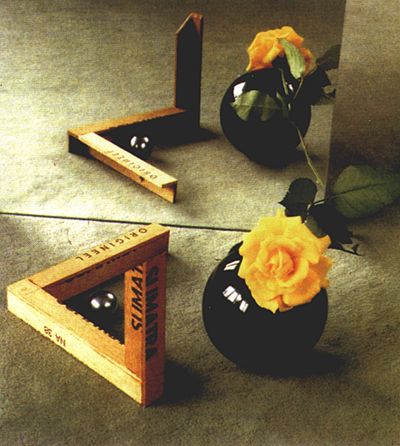
2D Penrose triangle
The reason your mind creates a show for you is to sell you the world and to interpret it for you in a stimulating and meaningful. A theater is not a replica of the world it is a place where scenes from the world are acted out to comment and enrich the Crowds by watching it. We go to be entertained and educated. The crowd wants to experience the added magic of watching a symbolic representation. Such it is with our minds Magic Show. It attempts to persuade us emotionally to enjoy the Show of the world. It is one part of our brain staging a show for another part of the brain. A little like the illustration below.

Origins of the show

Sensations have always been a kind of show. It has been a bodily representation of the world around us.
From the very first floating single cell organisms in the pre-cambrian waters beginning to register light and respond to changes in the water pressure as bigger predatory species swam by there has bee some sort of interpretation of the stimulus. What the organism feels is not what happens on the outside. In this way the mental world is fundamentally a representation of the world.
In the very beginning the change of light or pressure might have simply triggered a physiological response such as a flutter of the body to illicit movement and escape or perhaps to get closer to the stimulus. The next step would then be for the organism to be able to delay or choose which response to take to the stimulus. For this to happen the process becomes internalized, or privatized. It was no longer just an instinctual one step response. It would benefit the organism greatly to be able to choose its mode of outward behavior depending on the individual situations. To do this the internal theater had to begin. A very rudimentary representation of the outside world would be needed for the organism to choose. The stimulus would not just be objective anymore but highly subjective, since the immediate needs to stay alive are absolutely based on the subject experiencing the stimulus. 

"Sensation has always been theater of sorts. Its been been theater from the start but it was not magical theater. "

Once the theater of outside stimulation has begun, the leap towards being able to let the scenes run without the actual physical stimulus triggering it is not too great. Becoming what if? Rather than it is.
If the organism now instead of acting instinctively and immediately on the sensory input, one can easily imagine that the original evolutionary use for a reaction to stimuli would become outdated and needing a different response. For this to be possible the responses should become internalized and later evaluated for best possible response.

Why this theater?

Just how does this Theater pay off in terms of biological survival? "How can watching the show be genuinely life enhancing?"
In the process of becoming and remaining conscious, in the simple pleasure of being there, we discover a new purpose.
“The great object of life is Sensation - to feel that we exist - even though in pain - it is this "craving void" which drives us to gaming - to battle - to travel - to intemperate but keenly felt pursuits of every description whose principal attraction is the agitation inseparable from their accomplishment.”


Why, you might ask, would an organism develop enjoyment from the feeling of existence? Well, the beings that enjoys existence would develop a will to live.
Natural selection makes things that are important for the continuation of life pleasurable. Take sex for instance, or eating and drinking. So here we have a case for our consciousness making our experience of the world around us awesome.

From Nicholas Humphrey's book soul dust
The sensations we get from seeing the red of a tomato are actually formed in us. They are not inherent in the tomato itself. What we experience as red is simply a refraction of light at a particular wave length. But since every time we see a tomato we feel the effects of the red, deliciousness we begin to connect the two. In this way we now experience that the tomato is sending out something, and that something is more than just sitting there, it is indeed like a kind of communication, this at least is our experience of it. Like the tomato is sitting there showing us how red and delicious it looks.
So strictly speaking the world just sits there, but through our experience of it we feel like it is speaking to us, it is enticing us and stimulating us and this is a pleasurable process. We basically enchant ourselves into loving life. 

Drugs

We watch the Magic Show in our minds and through it fall deeper in love with the world. This is why we love the world around us more whilst on mind altering drugs. They enhance our mental representations and all of a sudden the colour of a tomato or the complex details in the bark of a tree becomes staggeringly beautiful and interesting. We get the feeling that the world is sweetly shouting its beauty and its multi level existence to us. The world is always talking to us, giving us the feeling it is revealing but a tiny substrate of its nature but on drugs its shouting.
The experience of perception blows children away and can make them stop in their tracks to study a browning leaf or a bit of silver foil from a cigarette packet as if it were the greatest treasure.
As we get used to the experience of perceiving the world we begin taking it for granted and stop noticing the magic, the novelty wears off.
This is the catch 22 of being a Showman with a novelty act; once people have seen you, the novelty wears off and you become 'just' an act. But put us in a different show, change costume and alter your patter and all of a sudden the experience for the Crowd becomes Novel again, this is what drugs do to us; they enhance our experience of the world. 
With or without drugs we enhance the world and our experience of it. Our Magic Theater gives significance and glow to everything in the world and this is why we feel so connected to it. It transforms the world into an awesome place. "All the more astounding because of the intimate connection we feel we have to it."
Watching a fire or a swirling pool of water we sometimes get knocked back by the immense beauty of it and our sense of union with it. This happens because in the simple act of perception there is an awesome Magical Theater production enhancing the world. 

We are constantly blown away by the feeling that the universe speaks directly to us, like in a way we are the only or at least most significant spectator to it and so say all of us. We are all the focal point of the universe and we are all creating its awesomeness in our minds, in fact that is the fundamental principle of consciousness; a Magical Theater of the mind to please and enchant our souls.

In this view we find individualism, but that is not the end. For as we experience the awesomeness of a sunrise we are immediately closer to the thought of what does this feel like to others. So in this way the creation of awe in us connect us to others and engage us in sharing the awesomeness of the world. From here comes The One Who Face the Other Way.