"I don't have to leave.
I lied."
Showing posts with label Showman. Show all posts
Tuesday, 20 November 2012
Steve Martin Funny Man
This guy was a real Showman, still is in some ways, but here we see him doing our kind of material. In a time when there were no avenue for his work he carved it out on the folk music scene. All respects, and what a demon on the banjo.
Wednesday, 7 November 2012
Creating Art FOR the Crowd
--> ..."the reason she'd never heard of me was because I was famous."
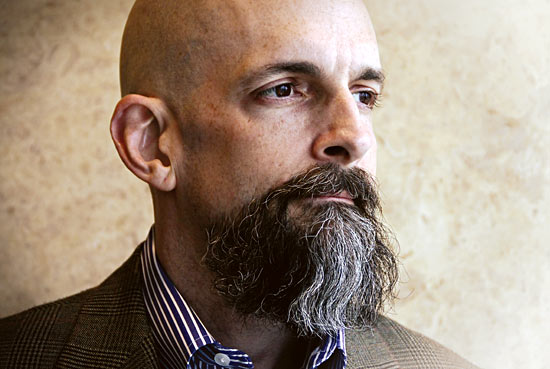
| Neil Stephenson, writer and honorary Showman. |
[A] while back, I went to a writers' conference. I was making chitchat with another writer, a critically acclaimed literary novelist who taught at a university. She had never heard of me. After we'd exchanged a bit of of small talk, she asked me "And where do you teach?" just as naturally as one Slashdotter would ask another "And which distro do you use?"
I was taken aback. "I don't teach anywhere," I said.
Her turn to be taken aback. "Then what do you do?"
"I'm...a writer," I said. Which admittedly was a stupid thing to say, since she already knew that.
"Yes, but what do you do?"
I couldn't think of how to answer the question---I'd already answered it!
"You can't make a living out of being a writer, so how do you make money?" she tried.
"From...being a writer," I stammered.
At this point she finally got it, and her whole affect changed. She wasn't snobbish about it. But it was obvious that, in her mind, the sort of writer who actually made a living from it was an entirely different creature from the sort she generally associated with.
And once I got over the excruciating awkwardness of this conversation, I began to think she was right in thinking so. One way to classify artists is by to whom they are accountable.
The great artists of the Italian Renaissance were accountable to wealthy entities who became their patrons or gave them commissions. In many cases there was no other way to arrange it. There is only one Sistine Chapel. Not just anyone could walk in and start daubing paint on the ceiling. Someone had to be the gatekeeper---to hire an artist and give him a set of more or less restrictive limits within which he was allowed to be creative. So the artist was, in the end, accountable to the Church. The Church's goal was to build a magnificent structure that would stand there forever and provide inspiration to the Christians who walked into it, and they had to make sure that Michelangelo would carry out his work accordingly.
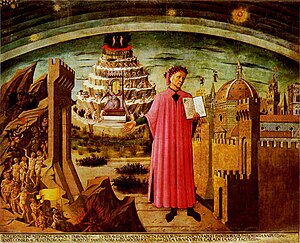
Dante holding his most famous book.
Similar arrangements were made by writers. After Dante was banished from Florence he found a patron in the Prince of Verona, for example. And if you look at many old books of the Baroque period you find the opening pages filled with florid expressions of gratitude from the authors to their patrons. It's the same as in a modern book when it says "this work was supported by a grant from the XYZ Foundation."
Nowadays we have different ways of supporting artists. Some painters, for example, make a living selling their work to wealthy collectors. In other cases, musicians or artists will find appointments at universities or other cultural institutions. But in both such cases there is a kind of accountability at work.
A wealthy art collector who pays a lot of money for a painting does not like to see his money evaporate. He wants to feel some confidence that if he or an heir decides to sell the painting later, they'll be able to get an amount of money that is at least in the same ballpark. But that price is going to be set by the market---it depends on the perceived value of the painting in the art world. And that in turn is a function of how the artist is esteemed by critics and by other collectors. So art criticism does two things at once: it's culture, but it's also economics.
There is also a kind of accountability in the case of, say, a composer who has a faculty job at a university. The trustees of the university have got a fiduciary responsibility not to throw away money. It's not the same as hiring a laborer in factory, whose output can be easily reduced to dollars and cents. Rather, the trustees have to justify the composer's salary by pointing to intangibles. And one of those intangibles is the degree of respect accorded that composer by critics, musicians, and other experts in the field: how often his works are performed by symphony orchestras, for example.
| Beowulf |
The novel is a very new form of art. It was unthinkable until the invention of printing and impractical until a significant fraction of the population became literate. But when the conditions were right, it suddenly became huge. The great serialized novelists of the 19th Century were like rock stars or movie stars. The printing press and the apparatus of publishing had given these creators a means to bypass traditional arbiters and gatekeepers of culture and connect directly to a mass audience. And the economics worked out such that they didn't need to land a commission or find a patron in order to put bread on the table. The creators of those novels were therefore able to have a connection with a mass audience and a livelihood fundamentally different from other types of artists.
Nowadays, rock stars and movie stars are making all the money. But the publishing industry still works for some lucky novelists who find a way to establish a connection with a readership sufficiently large to put bread on their tables. It's conventional to refer to these as "commercial" novelists, but I hate that term, so I'm going to call them Beowulf writers.
But this is not true for a great many other writers who are every bit as talented and worthy of finding readers. And so, in addition, we have got an alternate system that makes it possible for those writers to pursue their careers and make their voices heard. Just as Renaissance princes supported writers like Dante because they felt it was the right thing to do, there are many affluent persons in modern society who, by making donations to cultural institutions like universities, support all sorts of artists, including writers. Usually they are called "literary" as opposed to "commercial" but I hate that term too, so I'm going to call them Dante writers. And this is what I mean when I speak of a bifurcated system.
Like all tricks for dividing people into two groups, this is simplistic, and needs to be taken with a grain of salt. But there is a cultural difference between these two types of writers, rooted in to whom they are accountable, and it explains what MosesJones is complaining about. Beowulf writers and Dante writers appear to have the same job, but in fact there is a quite radical difference between them---hence the odd conversation that I had with my fellow author at the writer's conference. Because she'd never heard of me, she made the quite reasonable assumption that I was a Dante writer---one so new or obscure that she'd never seen me mentioned in a journal of literary criticism, and never bumped into me at a conference. Therefore, I couldn't be making any money at it. Therefore, I was most likely teaching somewhere. All perfectly logical. In order to set her straight, I had to let her know that the reason she'd never heard of me was because I was famous.
All of this places someone like me in critical limbo. As everyone knows, there are literary critics, and journals that publish their work, and I imagine they have the same dual role as art critics. That is, they are engaging in intellectual discourse for its own sake. But they are also performing an economic function by making judgments. These judgments, taken collectively, eventually determine who's deemed worthy of receiving fellowships, teaching appointments, etc.
The relationship between that critical apparatus and Beowulf writers is famously awkward and leads to all sorts of peculiar misunderstandings. Occasionally I'll take a hit from a critic for being somehow arrogant or egomaniacal, which is difficult to understand from my point of view sitting here and just trying to write about whatever I find interesting. To begin with, it's not clear why they think I'm any more arrogant than anyone else who writes a book and actually expects that someone's going to read it. Secondly, I don't understand why they think that this is relevant enough to rate mention in a review. After all, if I'm going to eat at a restaurant, I don't care about the chef's personality flaws---I just want to eat good food. I was slagged for entitling my latest book "The System of the World" by one critic who found that title arrogant. That criticism is simply wrong; the critic has completely misunderstood why I chose that title. Why on earth would anyone think it was arrogant? Well, on the Dante side of the bifurcation it's implicit that authority comes from the top down, and you need to get in the habit of deferring to people who are older and grander than you. In that world, apparently one must never select a grand-sounding title for one's book until one has reached Nobel Prize status. But on my side, if I'm trying to write a book about a bunch of historical figures who were consciously trying to understand and invent the System of the World, then this is an obvious choice for the title of the book. The same argument, I believe, explains why the accusation of having a big ego is considered relevant for inclusion in a book review. Considering the economic function of these reviews (explained above) it is worth pointing out which writers are and are not suited for participating in the somewhat hierarchical and political community of Dante writers. Egomaniacs would only create trouble.
Mind you, much of the authority and seniority in that world is benevolent, or at least well-intentioned. If you are trying to become a writer by taking expensive classes in that subject, you want your teacher to know more about it than you and to behave like a teacher. And so you might hear advice along the lines of "I don't think you're ready to tackle Y yet, you need to spend a few more years honing your skills with X" and the like. All perfectly reasonable. But people on the Beowulf side may never have taken a writing class in their life. They just tend to lunge at whatever looks interesting to them, write whatever they please, and let the chips fall where they may. So we may seem not merely arrogant, but completely unhinged. It reminds me somewhat of the split between Christians and Faeries depicted in Susannah Clarke's wonderful book "Jonathan Strange and Mr. Norrell." The faeries do whatever they want and strike the Christians (humans) as ludicrously irresponsible and "barely sane." They don't seem to deserve or appreciate their freedom.
...
Later at the writer's conference, I introduced myself to someone who was responsible for organizing it, and she looked at me keenly and said, "Ah, yes, you're the one who's going to bring in our males 18-32." And sure enough, when we got to the venue, there were the males 18-32, looking quite out of place compared to the baseline lit-festival crowd. They stood at long lines at the microphones and asked me one question after another while ignoring the Dante writers sitting at the table with me. Some of the males 18-32 were so out of place that they seemed to have warped in from the Land of Faerie, and had the organizers wondering whether they should summon the police. But in the end they were more or less reasonable people who just wanted to talk about books and were as mystified by the literary people as the literary people were by them. "It is well worth clicking over to Slashdot and read the full interview.
Tuesday, 3 April 2012
The One Who Faces The Other Way
The faithful readers of this web publication will know that lately I have been taking an interest in who the showman is? Our role; what is it, and where did it come from? Not an unreasonable question for those of us who have made the showman's Craft our Vocation. Without a firm foundation even the acrobats fall down.
In this article I will take a deeper look at - The One Who Faces the Other Way - (Described in our manifesto.)
Sociality
We are a social species, we need others to thrive, both for our well-being and our survival. Because this is so important, nature guides us towards it with rewards of good feelings. We feel good in others' company. Song and dance rouse our emotions, like nothing else, the production of opiates to bring about states of elation and euphoria.
Our biology guides us with pleasure. Sex feels real good because it is so important. Making the important things pleasurable and enjoyable so you will want to do it is nature's guide. It is where we learn whats important. Human rights are based on human need. The rewarding feelings we have when we share each other's company is your body telling you it's good for you, and therefor an important subject for attention.
Attention
An important part of what makes us human and what helped forge our social bonds is our ability to direct attention. Sharing attention by giving and taking mental focus is key to the social process. We crave getting and giving attention. It is as important as oxygen and nutrition for us. In this process we humans far surpass any other animal in our desire and ability to maintain focused attention for very long periods of time. By sharing attention we transmit meaning, tell story, laugh, and fall in love, all our most human aspects.
When we share attention we face each other. We direct our gaze towards those we engage with.
Face to face. One sharing thoughts, ideas and emotions with the other. From each other's faces we can easily read and unconsciously interpret so much subtle information.
Directing attention can be done in many ways, with hand gestures or simply with the eyes. The ability to use our eyes has been so important that evolution has shaped the way our eyes look to make them better suited to the task. The iris and pupil being dark against the white of our eyes makes it very easy to spot exactly what the person is looking at. This kind of adaption is to be expected since we are such a visually oriented species. Apes are also social but the fact that our eyes changed since we split off on our journey towards becoming a separate species, gives us a clue to the further importance sociability had for us.
We are the species with the most complex and advanced sociality. Other species like bees, ants, sheep, chimpanzees and praerie dogs all show different aspects of social behavior, but none are as varied and, most importantly, as adaptable as us. Some biologists calls us an "ultrasocial species".
Within the preceding paragraphs I believe we see the very process that drove the development of our Craft. People want attention, but people only willingly give it if you deserve to get it and keep it. Our ancestors would learn how to get attention but also needed to learn and develop how to be worthy of keeping it. They explored human nature and psychology as they investigated what was worthy of attention and how to present those things in the most interesting way.
Showman
From the word Showman we get all the information we need in regards to who he is and what his role and purpose is.
First I would like to propose that the term 'man' in Showman is to be understood as the 'man' in human. Not a gender specific ending. With this the term changes meaning from one man to Mankind. It describes a particular kind of person, not in terms of sex but of vocation.
The vocation or calling of the Showman is to show things to others in an interesting and joyful way. Like musicians shape and refine sounds, we have refined the process of 'sharing by showing'.
For me the best way to describe what our fundamental role is: "One Who Faces The Other Way."
A Showman is One Who Faces the Other Way.
One that has walked with the crowd
then turned around to face the others.
He cries for attention
and has something to Show
when he gets it.
(an Illuminated Showman's Manifesto)
One who get other's attention and knows how to make it worthwhile. One who has understood the power which lies in this and the importance of the Material being worth sharing.
A good Showman will pay attention to his Crowd's reaction and shape his presentation to suit them. Tuning and teasing a biological system of reward meant to guide us to what's important for our existence and well being.
One interpretation of the term would be: one which is pleasurable or interesting to watch. This seems simple but because of its primacy the feeling of shared attention is very fundamental and deeply rewarding. By getting and holding attention and skillfully directing it, the Showman engages and gives his Crowd a good time. This is a very meaningful and joyful social interaction. Something which strengthens the Showman's position in the group.
When one person faces the others to tell a thrilling tale of today's hunt, and tells it in a way that transports the Crowd right into in the midst of hooves kicking and blood running, a Crowd experiences great pleasure.
Our Tradition
We modern Showmen are the latest in a tradition of shapers of the special relationship that exists between people, ie sociability. This trait might well have been the fundamental characteristic setting us on our path to become human. The Shamen and story tellers of the cavemen and early hunter gatherer tribes all grasped and practiced the things we do. Their repertoire, routines and material were different, but the tool of showmanship, our illustrious Craft, was the same.
Whenever someone belittles your Craft as 'just
entertainment,' maybe as opposed to art, know that your vocation has a
deeper and richer history than the written plays and theatrical
productions of the rich and powerful. We Showmen were engaging, educating and healing Crowds tens of
thousands of years before the invention of writing. The Art they speak
of is a Johnny-come-lately to the unique powers of Those Who Faces
The Other Way. Their Art is but a particular aspect of our Craft.
Whilst the rich and intelligent gathered in theaters and operas, our kind were on every street corner and wherever people gathered. We are from the people, for the people.
What we do, in circuses, pubs and cabarets, we do because people like it. Like how the sexual preference of the pea hen shaped and created the peacock's formidable and encumbering tail, Crowds have shaped the Showman's material. What we find in carnivals is the sum of what thrills, pleases, and fascinates humankind.
The Crowd and their attention is what gives purpose to the showman's vocation. He is a bringer of joy and insight to others. This is his responsibility, to leave the Crowd Illuminated through sheer joy, arousal or through intellect. The Showman enjoys getting the attention and because of his skill in holding and shaping it the Crowds loves giving it. It is a win win situation.
In this article I will take a deeper look at - The One Who Faces the Other Way - (Described in our manifesto.)
Sociality
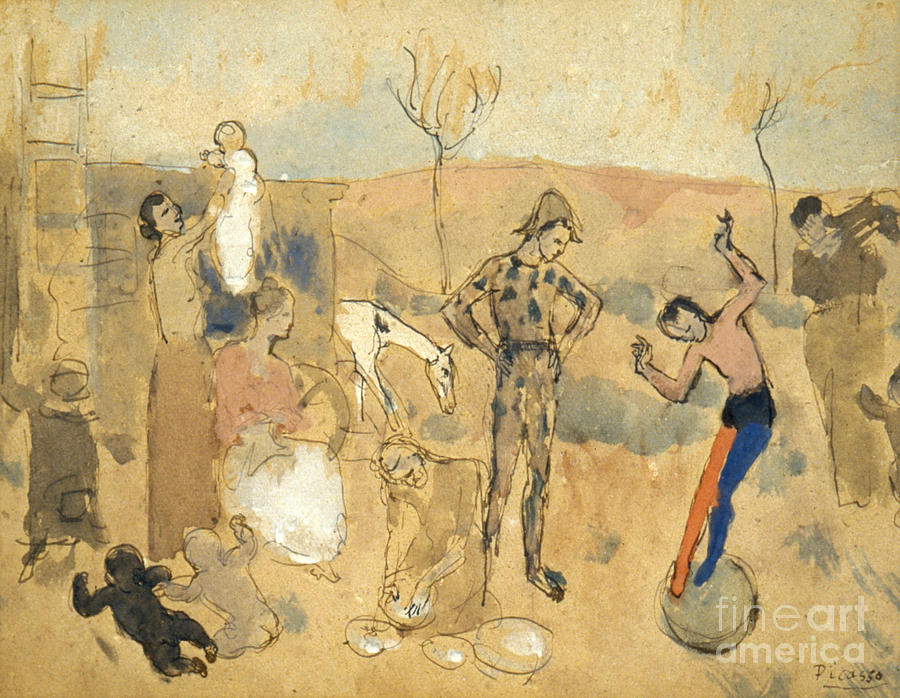
| Picasso: Circus Family, 1905. |
Our biology guides us with pleasure. Sex feels real good because it is so important. Making the important things pleasurable and enjoyable so you will want to do it is nature's guide. It is where we learn whats important. Human rights are based on human need. The rewarding feelings we have when we share each other's company is your body telling you it's good for you, and therefor an important subject for attention.
Attention
An important part of what makes us human and what helped forge our social bonds is our ability to direct attention. Sharing attention by giving and taking mental focus is key to the social process. We crave getting and giving attention. It is as important as oxygen and nutrition for us. In this process we humans far surpass any other animal in our desire and ability to maintain focused attention for very long periods of time. By sharing attention we transmit meaning, tell story, laugh, and fall in love, all our most human aspects.
When we share attention we face each other. We direct our gaze towards those we engage with.
Face to face. One sharing thoughts, ideas and emotions with the other. From each other's faces we can easily read and unconsciously interpret so much subtle information.
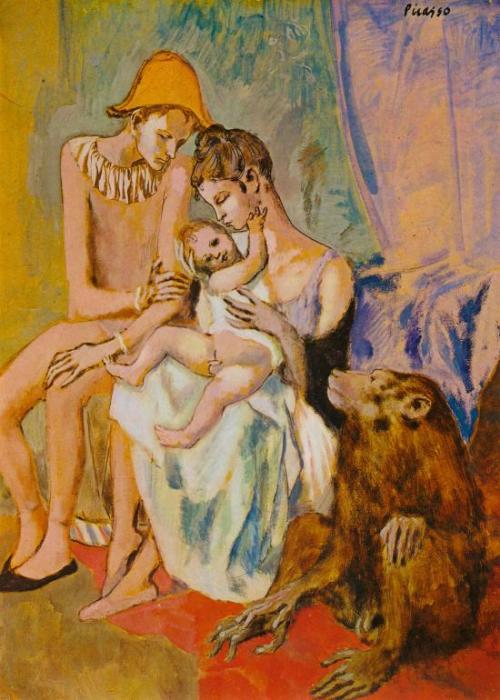
| Harlequin’s Family With an Ape (1905) |
We are the species with the most complex and advanced sociality. Other species like bees, ants, sheep, chimpanzees and praerie dogs all show different aspects of social behavior, but none are as varied and, most importantly, as adaptable as us. Some biologists calls us an "ultrasocial species".
Primatologist Michael Chance recognized that subordinates pay disproportionate attention to dominants, glancing at them far more than the dominants at the subordinates, and proposed that the social organization of attention has been a crucial factor in human evolution. He observed that hierarchy establishes itself rapidly among children, whose status can be ranked accurately according to the frequency with which they are looked at by three other children simultaneously.
A chimpanzee uncertain that it can gain rank through force or threat can often improve its status by other attention-getting devices - doing tricks and 'showing off.' Children do the same thing, often accompanied by cries of 'look at me.' But children also soon learn about others' emotional resistance to the undeserved usurpation of attention, and our consequent dislike of showoffs or bores.
From Brian Boyd's excellent book Origin of Stories.
Within the preceding paragraphs I believe we see the very process that drove the development of our Craft. People want attention, but people only willingly give it if you deserve to get it and keep it. Our ancestors would learn how to get attention but also needed to learn and develop how to be worthy of keeping it. They explored human nature and psychology as they investigated what was worthy of attention and how to present those things in the most interesting way.
Showman
From the word Showman we get all the information we need in regards to who he is and what his role and purpose is.
First I would like to propose that the term 'man' in Showman is to be understood as the 'man' in human. Not a gender specific ending. With this the term changes meaning from one man to Mankind. It describes a particular kind of person, not in terms of sex but of vocation.
The vocation or calling of the Showman is to show things to others in an interesting and joyful way. Like musicians shape and refine sounds, we have refined the process of 'sharing by showing'.
For me the best way to describe what our fundamental role is: "One Who Faces The Other Way."
A Showman is One Who Faces the Other Way.
One that has walked with the crowd
then turned around to face the others.
He cries for attention
and has something to Show
when he gets it.
(an Illuminated Showman's Manifesto)
One who get other's attention and knows how to make it worthwhile. One who has understood the power which lies in this and the importance of the Material being worth sharing.
A good Showman will pay attention to his Crowd's reaction and shape his presentation to suit them. Tuning and teasing a biological system of reward meant to guide us to what's important for our existence and well being.
One interpretation of the term would be: one which is pleasurable or interesting to watch. This seems simple but because of its primacy the feeling of shared attention is very fundamental and deeply rewarding. By getting and holding attention and skillfully directing it, the Showman engages and gives his Crowd a good time. This is a very meaningful and joyful social interaction. Something which strengthens the Showman's position in the group.
When one person faces the others to tell a thrilling tale of today's hunt, and tells it in a way that transports the Crowd right into in the midst of hooves kicking and blood running, a Crowd experiences great pleasure.
Our Tradition
We modern Showmen are the latest in a tradition of shapers of the special relationship that exists between people, ie sociability. This trait might well have been the fundamental characteristic setting us on our path to become human. The Shamen and story tellers of the cavemen and early hunter gatherer tribes all grasped and practiced the things we do. Their repertoire, routines and material were different, but the tool of showmanship, our illustrious Craft, was the same.
| From tomb 15 in Beni Hassan, - 4000 years old. |
Whilst the rich and intelligent gathered in theaters and operas, our kind were on every street corner and wherever people gathered. We are from the people, for the people.
What we do, in circuses, pubs and cabarets, we do because people like it. Like how the sexual preference of the pea hen shaped and created the peacock's formidable and encumbering tail, Crowds have shaped the Showman's material. What we find in carnivals is the sum of what thrills, pleases, and fascinates humankind.
The Crowd and their attention is what gives purpose to the showman's vocation. He is a bringer of joy and insight to others. This is his responsibility, to leave the Crowd Illuminated through sheer joy, arousal or through intellect. The Showman enjoys getting the attention and because of his skill in holding and shaping it the Crowds loves giving it. It is a win win situation.
Monday, 27 February 2012
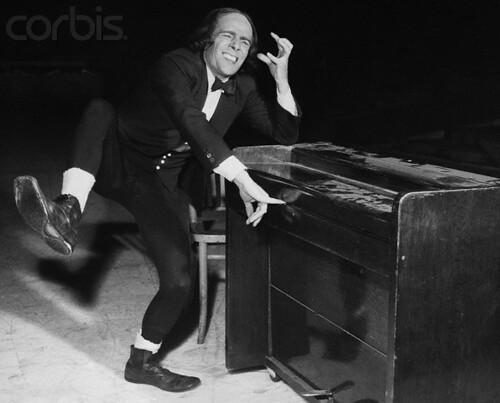
Max Wall: Funny Man
Max Wall, born Maxwell George Lorimer (12th March 1908 - 21st May 1990), was an English comedian and actor, whose performing career covered music hall, theatre, films and television. He is best remembered for his ludicrously attired and hilariously strutting Professor Wallofski. This creation notably influenced John Cleese, who has acknowledged Max Wall's influence on the creation of his own Ministry of Silly Walks sketch for Monty Python.
After appearing in many musicals and stage comedies in the 1930s, Wall's career went into decline, and he was reduced to working in obscure nightclubs. He then joined the Royal Air Force during World War II and served for three years until he was invalided out in 1943. Wall re-emerged during the 1950s when producers and directors rediscovered his comic talents, along with the expressive power of his tragic clown face and the distinctive sad falling cadences of his voice.
He secured television appearances and, having attracted Samuel Beckett's attention, he won parts in Waiting for Godot and Krapp's Last Tape.
On the afternoon of 20th May 1990, Wall fell at Simpson's Restaurant in central London, fracturing his skull. He never regained consciousness, and died early the next morning at Westminster Hospital. He was 82.
A ten minute biography from channel 4's (UK) Heroes of Comedy.
Max Wall attempts Rachmaninoff. From the 1975 film Max Wall: Funny Man.
A fine selection (edited with some repetitions to a ska track...) of Max's superb comedic physicality.
Facial Contortions of an older Funny Man
Wednesday, 22 February 2012
Johnny Puleo's Harmonica Slapstick
JOHNNY PULEO and his Harmonica Gang was a hard hitting kicking harmonica slapstick troupe.
Apparently they were one of George Carl's sources of inspiration.
(Thanks to Ira Seidenstein for this anecdote.)
Wikipedia on Puleo:
I have included three clips, for those just browsing you'll see what you need in the first one or two, but for the arduous students of slapstick to see the permutations of the gags and the changes and additions to the act is very interesting.
Here is in all his angry Italian dwarf glory. Not pulling any punches. Funny as all that, from Hollywood Palace, 1965.
Hollywood Palace, 1966.
the Moulin Rouge in 1954.
Apparently they were one of George Carl's sources of inspiration.
(Thanks to Ira Seidenstein for this anecdote.)
Wikipedia on Puleo:
Johnny Puleo (October 7, 1907 - May 3, 1983) was an American musician and actor, who specialized in playing the harmonica.As an actor he appeared perhaps most notably in the film Trapeze. But acting schmacting - the man was a fantastic slapstick Showman and a virtuouso on the harmonica.
I have included three clips, for those just browsing you'll see what you need in the first one or two, but for the arduous students of slapstick to see the permutations of the gags and the changes and additions to the act is very interesting.
Here is in all his angry Italian dwarf glory. Not pulling any punches. Funny as all that, from Hollywood Palace, 1965.
Hollywood Palace, 1966.
the Moulin Rouge in 1954.
Friday, 30 September 2011
Shaman Showman - part 3
The Shaman-Showman's Obligation
Wikipedia tells us: Shamanism is an anthropological term referencing a range of beliefs
and practices regarding communication with the spiritual world. There is a lot
of research done by anthropologists and religious historians like Mircea Eliade
that explores this line of thought. Daniel Pinchbeck defines Shamanism as “A
technology for exploring non-ordinary states of consciousness in order to
accomplish specific purposes: healing, divination, and communication with the
spirit realm.”
Personally I
don’t believe there is any need to postulate a spiritual world as a separate
realm of existence to explain phenomena in this world. I believe the answers to
our questions and mysteries lies firmly rooted in reality. Explanations given
along supernatural lines only complicates things and raises more questions then
it answers. In my writings I am treating the shaman as a guide for an
exploration of non-ordinary states of consciousness or an altered experience of
reality. Lessons learnt in this state of mind does not teach us about the
spirit world but about ourselves and our place in the real world.
I believe the
shamanistic tradition and experience has been important for humans for the same
reasons as religion. The beneficial traits of these traditions has worked to
strengthen unity, binding communities, finding meaning in complex things by
providing answers to unexplainable things, and it exists throughout the world,
most likely because it’s positive effects are real, regardless of the ultimate
veracity of the teachings. I will get back to these underlying positive effect
in another post.
Blogger Tai Carmen describes the shamanistic state eloquently in a great post on her blog:
“A systematized disorganization of the senses via trance states induced by
intoxicants/hallucinogenics, music and/or dance, with the goal of personal
transformation/liberation from social constraints, and communion with a divine
or supernatural principal. ”
The tools of
the trade seems to be drums, chanting, and also demonstrations of supernatural
skill. All employed to bring the participants a state of ecstasy. A word whose
original meaning came from the Greek word Ekstasis, which means ‘standing
outside oneself.’ He who stands outside himself would be able to see himself
from the outside.
The mindset
of the participants is described as a trance, but perhaps for those that can’t
or won’t reach the full ecstatic state themselves watches the shaman as a
representation of themselves. They watch the shaman as they watch themselves.
He becomes man’s representative, the symbolic human.
A Showman Shows Man - Man. For a Showman, the altered state is the mindset of the Crowd.
Their minds connected watching time slowed down and controlled by the Showman
as he draws them into a symbolic reality, and leads them into Ekstasis in its
original meaning, standing outside oneself to be able to watch and understand
oneself.
Shamans are
keepers of secret knowledge, they explain unexplainable events and increase the
odds of survival and the moral in the group. They are the mediators between the
spiritual or altered experience of reality and the real world. In this symbolic
world order they find hope of control over stochastic processes in the real
world.
The shaman manifests our dreams and collective imagination. They give
hope. Hope of healing, hope of direction when lost and so on. Through his role
as an outsider, a wounded healer, someone who has suffered and learnt, one who have
gone out on the ice and lived there alone for many months until he could
finally hear the voice of the Universe, have certain obligations to fulfil.
![]() |
| From BBC's Human Planet |
From the TV series Human Planet I learnt that on coral islands where it
is possible to fish within a lagoon as well as out on the open sea, fishermen
are more superstitious about fishing out at sea. This means there are more
rituals connected to the open sea variant. This is because added risks. Random
uncontrollable processes like bad weather and dangerous prey increase risk of
injury and death. The open ocean is a treacherous place and the beasts pulled
up can be dangerous. The more random the process, the easier it is for us to
become superstitious. Situations of gravity, such as open-sea fishing, or big
game hunting would all bring on a desire to control the outcome, to gain an
advantage and security in a very uncertain situation.
![]() |
| BF Skinners superstitious pigeon |
In risky circumstances
where randomness is unavoidable normal pattern recognition no longer suffice
and as demonstrated nicely by B.F. Skinners famous superstitious pigeons, our
minds makes sense of unrelated events and outcomes. The pigeons belived that
their actions such as wing flapping and turning was an important part of
receiving food. The fact was that the food was delivered completely at random
with no reference to the pigeon’s actions. When food was delivered the pigeon
remembered its last actions and attributed it to the food delivery. And hence
persisted to repeat the half turn, the wing flap and so forth it had done
immediately before the food arrived. The pigeons quickly developed a set of
beliefs to make sense of the randomness.
Minds were made to make sense of things and it is so eager to do so it
often makes sense out of things that have no sense at all. Mistaking events
following each other in time for causality, that the first event is linked to
the next. Like linking a successful and injury free hunt to correctly following
a groups rituals. If the ritual was executed and the ensuing hunt was
successful and injury free it would be attributed to the ritual. The tribe now
have ‘proof’ that the ritual worked. Once this thought pattern occurs it can be
very difficult to escape. To the point that if someone did die in the hunt, the
question would not be whether the whole system was wrong, but what alterations
must be done to the ritual, which bit was not done well enough, which part of
it failed. In this way a simple superstition can become a complex set of
instructions meaningful within the community’s belief system.
![]() |
| Minds makes sense of things that have no sense at all. |
Superstition aside, as I mentionioned earlier the veracity of the
beliefs seems to be unimportant. The benefits from following religious
practices and rituals are all equally helpful. We have yet to find one type of
prayer that gives 100% return of your prayers. All rituals and spiritual
traditions has similar outcomes so the important thing about them is that
something about them ‘works’ for us as humans.
The shamanistic ritual before the hunt becomes a time for focus and for
unification of the hunters and through them the whole tribe. It changes the
mindsets from I to We and in that there is immense power. We are social beings,
together we are invincible, together we will prevail, and together we shall
grow. This is the obligation of the Shaman Showman.
Subscribe to:
Posts (Atom)