Showing posts with label Jester. Show all posts

Monday, 16 November 2015

Clown Truth

Since the dawn of humanity clowns have danced a closely intertwined dance with truth. This dance is a fundamental feature of their timeless attraction. Truthfulness is, behind the mask of grotesque ridiculousness, what makes a clown. When a clown comes from a place of authenticity the clown can say things others wouldn’t dare. 

The clown is a liminal character, polarized between the lowest social standing and a unique position of receiving attention, which in and of itself is a form of social status. Attention not just from common people but also from the rich and powerful. In medieval times the court jester was a clown in service of a King or some other elevated noblemen. In this role jesters had unique access to, literally, the most powerful persons in the land. On top of that he had a unique permission to speak the truth.
The jester’s freedom to mock or contradict rulers is described in records from all over the world, throughout history. India, Persia, China, and Europe all had their own versions of it. Aztec regent Montezuma II (1502-20) said of his jesters: “They frequently pronounced some important truths,” and in Erasmus’ (1469-1536) Praise of Folly he writes: “They’re the only ones who speak frankly and tell the truth, and what is more praiseworthy than truth?”
We must assume Kings were fully aware of this aspect of their fools role. So they would take great care in selecting their court jester. To gain the privilege, of being taken care of and to possibly assert influence, the clown had to deserve it. Only masters of their craft would have gotten the honor of becoming court jesters. They would have had to be able to improvise and have a broad palette of skills to draw upon and combine as they in essence would perform to the same crowd repeatedly. Obviously they would also have to be compatible with as well as being stimulating to the individual King’s humor, taste, and temperament.  
From the Jester or Clowns point of view an important part of their education and development is to discover and develop a truthful representation of themselves. A character which can fall down, juggle, sing comic songs, tell stories or what have you, and  come across as being truthful and himself through it all. They need to be able to pretend without pretense. 

“The clowns who are masters are themselves. They make something wonderful out of who they truly, deeply and simply are. They don’t hide or conceal themselves in clown character, to appear as someone else, or someone good, or someone right. Yes, they borrow routines, shtick, and ideas from one another and their predecessors, and, true, they frequently belong to a long performance lineage and have learned, as apprentices, specific techniques that perpetuate a certain tradition. And yet whatever material they perform, whatever character they present, they enter into their clown persona as a way of being more generously themselves than they might be under usual circumstances. Every time we watch one of them, we don’t view a form or a character or a concept. We see, simply, them.” (Ezra LeBank and David Bridel, Clowns: In conversation with Modern Masters.)

There were of course particular, if unwritten, rules for the way these transgressive expressions of truth could be presented. Guised in silliness, displayed and expressed from a grotesque and lowly state of dignity, the King would be free to take from it what he wanted and discard the rest as jest and absurdity. If the King sifted out a grain of truth from the jesters rants and chose to take the it to heart it was more likely for the grain to fall on fertile ground. 
The jester could speak truths, but the telling of truth is not just a matter of stating facts.  “Earth is not the centre of the solar system,” might have been a fact when it was first uttered, but it was not experienced as such by the vast majority. The type of truth best expressed by jesters and clowns is not factual truth, what German film maker Werner Herzog calls “accountant’s truth,” but rather what he calls “ecstatic or poetic truth.” 
“If facts had any value, if they truly illuminated us, if they unquestionably stood for truth, the Manhattan phone directory would be the book of books.” (Werner Herzog. A Guide for the Perplexed.)
Facts might reflect objective reality, but they do not illuminate. Only truth illuminates. Poetic truth is an experienced truth, greater and more powerful than any fact. It is a process of communication where a recipient experiences someones expression as a deeper and more visceral truth. Poetic truth is not separate from human participation. It is not something which is, it is something which happens between humans. Poetic truth is artificial, meaning “made or produced by human beings rather than occurring naturally, typically as a copy of something natural.” (New Oxford American Dictionary.) A poetic truth is fact artificially crafted to make emotional connection.
For poetic truth to happen there needs to be trust between the presenter and the receiver. The King would have to trust his fool. For this trust to develop the fool had to express his self. If the King felt his jester spoke the opinions or truths of ministers or bishops, chances are the fool would have his privilege revoked, possibly by having his tongue ripped out or head chopped off.
 The process of telling truth is a delicate business. As a clown attempts to do so there is always risk. Risk of failure. Not the kind of failure which is mimicked in a clown’s performance, which in actuality is only imitation of failure so well crafted it really is a success, its rather a failure of communication, failure of connection and understanding. If any of these three factors fail; the truthfulness of the clown, the particular truth expressed, or the King’s experience of either, the clown risks death. The historical jester who’s truth broke down could probably face literal death. Todays clowns risks dying on stage. Certainly not as bad as death, anyone who isn’t a clown would say. Yet, the clown’s truth is the clown’s soul.  When a clown dies on stage the truth of his self fails, without which the poetic truth of his message can no longer happen. What dies, when a clown dies on stage, is his soul. Without it the clown is reduced to a soulless clown zombie. Wandering undead in greasepaint with a red nose being but an empty shell. A fate on par with death by royal executioner. (It’s zombie clowns like this, roaming shopping centers and birthday parties which is giving clowns a bad name.) 

 The truthfulness in the jesters persona is the key to his privilege as truth teller. When a clown successfully acts from his heart, the wellspring of poetic truth, truth can happen and rings true. In this subtle, yet powerful, process comes great power. Laughter and levity lowers the minds defense mechanisms, and as cynicism and distrust recedes, the listeners own heart becomes exposed, fertile ground. In such moments the heart of the jester can speak directly to the King’s heart and under these peculiar circumstances a lowly clown can plant a seed of poetic truth in the Kings heart. A seed which has the potential to sprout into governmental reform. If a clown whispers his truth to the King’s open heart, change becomes a possibility. Change of heart. Change of mind. Change of world.

Monday, 30 July 2012

Alan Watts - The Joker

The following is an audio clip by the luminary Alan Watts with words transcribed by yours truly.
Alan Wilson Watts (6 January 1915 – 16 November 1973) was a British philosopher, writer, and speaker, best known as an interpreter and populariser of Eastern philosophy for a Western audience. {Wiki}


"In some ways the joker and a monk has similar functions. The monk is a person who abandons society, he is an outlaw only he is on the upper side rather than on the lower side . As the ordinary criminal is below caste the outlaw in the sense of the monk is an abovecast. In the time of Buddha his followers wore orange robes because those were the garments of criminals. (think orange overhauls of guantanamo bay) they wore the garbs of the lower outcasts but were respected as upper outcasts. In modern society its very difficult to be in this position."
"The worst kind of criticism is the one who pokes fun... The joker doesn't out rightly deride things, he is not a slapstick comedian, he gives people the giggles about things they thought were terribly sacred and that is extremely demoralizing."
"The Fool's standpoint is that all social institutions are games. He sees the whole world as game playing. That's why, when people take their games seriously and take on stern and pious expressions the Fool gets the giggles because he knows that it is all a game. Not a 'mere' game' or mere entertainment but it is not frivolous.
The idea of game is this, the nature of things are musical. There is no purpose beyond doing it. Music has no destination. It isn't aimed at the future, It does travels in time, but it doesnt aim at a goal in time. The point of music is every phrase at it unfolds itself and how you perceive their relationship to earlier and later phrases.
Music itself is dance. You dance to dance. Everything is its own point. Things develop. A seed becomes a tree. But the purpose of a seed could be thought to be the tree. That doesnt hold up since each tree makes new seeds. The aim is to go on and on and on. Life."

"The network of life has no other objective than to do what its doing..."

I do love the blessed thoughts of the Reverent Alan Watts

Thursday, 5 July 2012

Meaning In Entertainment

Rambling - under the influence

I struggle with the dichotomy of meaning and entertainment. Can I produce a show which at once is appealing to the mind and eternity as well as capturing the crowds imagination today?
The question is age old. Goethe writes about it in his Prologue In The Theatre from his Faust (1828) where three characters discusses the business of creating shows. The Manager character is interested in selling tickets and is trying to find the balance between the Jester and the Poet's contributions. The former is only interested in making the Crowd laugh and enjoy the moment whilst the Poet wants to create work that will last for eternity.
MANAGER
I wish the crowd to feel itself well treated,
Especially since it lives and lets me live;
The posts are set, the booth of boards completed.
And each awaits the banquet I shall give...
...How shall we plan, that all be fresh and new,—
Important matter, yet attractive too?

POET
What dazzles, for the moment born, must perish;
What is genuine posterity will cherish.

JESTER
Posterity! Don’t name that word to me!
If I should choose to preach Posterity,
Who shall entertain the Crowds today?

Jeff Koon's balloon dog at Versailles. 
So the problem is old and touched upon in much great literature. In studying these issues I have lately wandered into the camp of science fiction. I believe there are certain similarities between the literary sub genre of science fiction and the Craft of the Showman. For both are areas of art which many will simply brush away as 'mere' entertainment without taking any closer look at it. I readily admit that there are much empty chatter and mindless drivel produced both within science fiction and circus, but amongst all the dirt, gems of diamond quality is unearthed.
Is it so that even these gems are reserved for people with special interest in the genres or can they reach beyond their fans? And ultimately, does it matter if they do? We are in the show business which requires both the show and the business to be successful if we Showmen are to put nutritious and varied food on our tables.

I have been reading the underrated and relatively unknown polish science fiction writer Stanislaw Lem recently. For those of you that don't know this writer here follows Wired description of him:
Stanislaw Lem has never been beloved by the science fiction establishment. Philip K. Dick accused him of being a communist agent. Members of the Science Fiction Writers Association booted him from their group. And no wonder: Lem has denounced popular sci-fi as trivial pulp produced by mental weaklings. Science fiction, he once wrote, "is a whore," prostituting itself "with discomfort, disgust, and contrary to its dreams and hopes." But strained relations with his peers hasn't tarnished Lem's career. The author of dozens of books translated into 40 languages, he is considered among the greatest sci-fi writers of all time.

So why is it that Isaac Asimov and Arthur C. Clarke are household names, but Stanislaw Lem remains unknown to so many Americans? Start with the obvious: Lem writes in Polish. His most important books have never appeared in English. Even his best-known novel, Solaris, is available in US bookstores only as an English translation of a French abridgement of the Polish original. Yet the main reason Lem's never become established here is that his wit has always been too cruel, his love of science too prominent, his outlook too cerebral to fit easily into a publishing niche devoted to fairy-tale adventures and timeworn astronaut yarns.
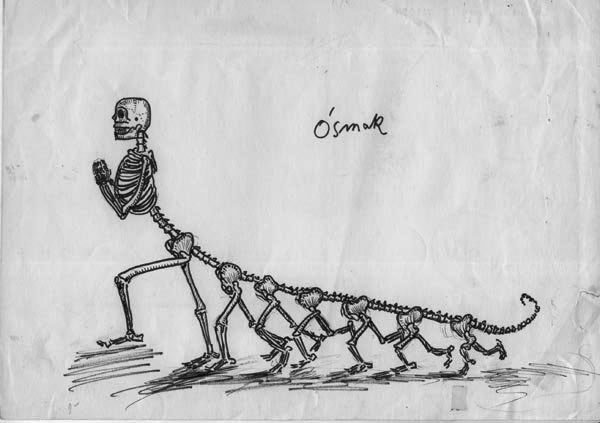
Drawing by Stanislaw Lem
 In this description I find Lem to be a kindred spirit, one who seeks to inject some important and deeper subjects into a genre which so often is looked down upon by the literary elite, possibly for good reason.

"We are all lying in the gutter, but some of us are looking at the stars."

In his essay "Phillip K Dick: A visionary amongst the Charlatans," Stanislaw Lem brings up the subject of populism.
"Knight declared himself to have been mistaken earlier in attacking books by van Vogt for their incoherence and irrationalism, on the grounds that, if van Vogt enjoys an enormous readership, he must by that very fact be on the right track as an author, and that it is wrong for criticism to discredit such writing in the name of arbitrary values, if the reading public does not want to recognize such values. The job of criticism is, rather, to discover those traits to which the work owes its popularity. Such words, from a man who struggled for years to stamp out tawdriness in SF, are more than the admission of a personal defeat—they are the diagnosis of a general condition."
Should mass appeal make the work beyond reproach? I don't think so. Great art is rarely the most popular.

Does performances of the Carnival Arts have to loose their mass appeal when meaning is introduced? Let me rephrase the question. Does important topics necessarily make shows boring? I don't think they have to, but often they are.
Usually because the issues discussed in the performance are just that; discussed, or talked about. Some current political issue is just plastered on top of a performance like cheap wallpaper or shoved in between acts like mortar between tiles. This will not work. We must be more subtle and creative than that because our Crowds are smarter than that.
MANAGER
I know how one the People’s taste may flatter,
Yet here a huge embarrassment I feel:
What they’re accustomed to, is no great matter,
But then, alas! they’ve read an awful deal.

People say: nobody likes being preached to, but there are millions of religious people out there who gets preached at constantly so people can't mind it that much. I think it is a context thing. People don't mind being preached at when they are in church because they don't expect anything better from their local priest. Whilst when it comes to entertainment, they are a lot more choosy.
Squirrel powered musicbox
If a Showman has something to say, beyond the elements of his craft ie juggling, tightwire walking, magic etc, the Showman must make it funny or moving or scary or cool and fundamentally part of the act. Meaning should not be plastered over the top of an act it needs to be woven through it. Further and most importantly it needs to come across as real. If the person delivering the meaningful material doesn't believe in it 100% it will not work. But if they do share the passion so genuinely the Crowd might accept it and enjoy it in the most crude and preachy form, but I wouldn't rely on it. So make the meaning into material, treat the meaningful stuff with as much work as you do with your tricks and your Craft.
SO, for meaningful material to work it needs to be flawlessly integrated into the tricks and skill, it needs to be well crafted to hold its own as material whilst simultaneously ring true.

Most of the time when Showmen attempts this it falls flat, which must indicate it is a difficult thing to get right, but just because it's difficult doesn't mean we should stop trying. Rather the opposite. Like JFK said about the mission to get man to the moon:
"We choose to go to the moon in this decade and do the other things, not because they are easy, but because they are hard, because that goal will serve to organize and measure the best of our energies and skills, because that challenge is one that we are willing to accept, one we are unwilling to postpone, and one which we intend to win."

Saturday, 19 May 2012

Dario Fo - The Birth of the Jongleur

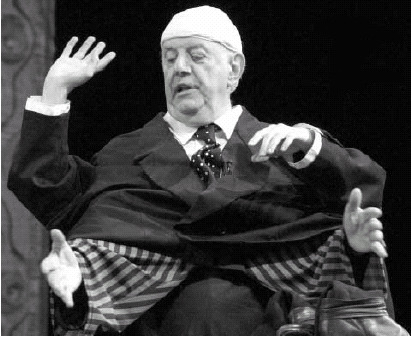
Dario Fo.
A jongleur was an itinerant medieval entertainer proficient in juggling, acrobatics, music, and recitation so in other words a Showman.
In 1997 Dario Fo was awarded the Nobel Prize for Literature for his book Mistero Buffo, Comic Mysteries. But it wasn't just a book, it was ancient stories Fo had collected and rewritten into one-person plays. In his performances he acted out all the roles in the tradition of a medieval jongleur who presents the underdog's disrespect for authority. The Nobel Prize press release describe their reason as giving him the award for "emulating the jesters of the Middle Ages in scourging authority and upholding the dignity of the downtrodden."

"He if anyone merits the epithet of jester in the true meaning of that word. With a blend of laughter and gravity he opens our eyes to abuses and injustices in society and also the wider historical perspective in which they can be placed. Fo is an extremely serious satirist with a multifaceted oeuvre. His independence and clear-sightedness have led him to take great risks, whose consequences he has been made to feel while at the same time experiencing enormous response from widely differing quarters."
Mixing the sacred and the burlesque, the episodes subvert accepted wisdom and challenge entrenched authority. Among the play’s twelve episodes the a key text is the Birth of a Jongeleur, an excerpt of this play on the Nobel's Committee's website. Her is the story in full, prefaced by some words about the text by Dario Fo himself.

Fresco from 1100 showing a
Jongleur in the role of drunkard.
"What does this piece relate? We see a jongleur, explaining how, before he became a jongleur, he was a peasant, and that it was Christ who changed him into a jongleur. How did it happen that Christ gave him this new profession? It was because he used to own land, but a landowner tried to take the land away from him. I say no more, because there's not really much that I can add. The piece speaks for itself. Don't worry if at first you don't understand some of what I say. The sense, the gestures and sounds inolved will help you. By my gestures and by the sounds of the piece, you will easily grasp the meaning of this."
The following piece is based on a comic mystery first written down in the thirteenth century.

THE BIRTH OF THE JONGLEUR
(Translated by Ed Emery in 1983.)

Kind people, gather round and listen. The jongleur is here! I am the jongleur. I leap and pirouette, and make you laugh. I make fun of those in power, and I show you how puffed up and conceited are the big-shots who go around making wars in which we are the ones who get slaughtered. I reveal them forwhat they are. I pull out the plug, and... pssss... they deflate. Gather round, for now is the time and place that I begin to clown and teach you. I tumble, I sing and I joke! Look how my tongue whirls, almost like a knife. Remember that. But I have not always been... Well, I would like to tell you how it was that I came to be.

I was not born a jongleur; I didn't suddenly turn up as I am now, with a sudden gust from the skies and, hopla, there I was: 'Good day... Hello'. No! I am the result of a miracle! A miracle which was carried out on me. Do you believe me? This is how it came about! I was born a peasant. A peasant? Yes, a real countryman. I was happy, I was sad, I had no land. No! I worked as all of us work in these valleys, wherever I could. And one day I came by a mountain, a mountain all of rock. It was nobody's. I found that out. I asked people. 'No! Nobody wants this mountain!'
Well, I went up to its peak, and I scratched with my nails, and I saw that there was a little bit of earth there, and I saw that there was a little trickle of water coming down. So I began to scratch further. I went down to the riverbank, and I wore my fingers to the bone bringing earth up onto this mountain. And my children and my wife were there. My wife is sweet, sweet and fair, with two round breasts, and a gentle way of walking that reminds you of a heifer as she moves. Oh, she is beautiful! I love her, and it gives me pleasure to speak of her.
Anyway, I carried earth up in my own hands, and the grass grew so fast! Pfff... ! It grew of its own accord. You've no idea how beautiful it was! It was like gold dust! I would stick in my hoe, and pfff... a tree sprang forth. That earth was a miracle! A marvel! There were poplars, oaks and other trees everywhere. I sowed them when the moon was right; I knew what had to be done, and there, sweet, fine, handsome crops grew. There was chicory, thistles, beans, turnips, there was everything. For me, for us!
Oh, how happy I was! We used to dance, and then it would rain for days on end, and then the sun would blaze, and I would come, and go, and the moons were always right, and there was never too much wind, or too much mist. It was beautiful, beautiful! It was our land. This set of terrace was really beautiful. Every day I built another one. It was like the tower of Babel, beautiful, with all these terraces. It was paradise, paradise on earth! I swear it. And all the peasants used to pass by, saying:
'That's amazing, look what you've managed to bring forth out of this pile of rocks! How stupid that I never thought of that!'

And they were envious. One day, the lord of the whole valley passed by. He took a look and said:
'Where did this tower spring up from? Whose is this land?'
'It's mine,' I said. 'I made it myself, with these hands. It was nobody's.'
'Nobody's? That 'Nobody's' is a word that doesn't exist. It's mine!'
'No! It's not yours! I've even been to the lawyer, and he told me it was nobody's. I asked the priest, and he said it was nobody's. And I built it up, piece by piece.'
'It's mine, and you have to give it to me.'
'I cannot give it to you, sir. I cannot go and work for others.'
'I'll pay you for it;I'll give you money. Tell me how much you want.'
'No! No, I don't want money, because if you give me money, then I'll not be able to buy other land with the money that you give me, and I'll have to go an work for others again. No, I don't want to. I won't.'
'Give it to me.'
'No!'
Then he laughed, and went away. The next day the priest came, and he told me:
'The land belongs to he Lord of the Valley. Be sensible, give it up. Don't play the fool. Beware, because he is a powerful, evil lord. Give up this land. In the name of God, be sensible!'
'No!' I told him. 'I won't.'
And I made a rude gesture at im with my hand. Then the lawyer arrived too. He was sweating, by heaven, when he came up the mountain to find me.
'Be sensible. There are laws... and you should know that you can't... that, for you...'
'No! No!'
And I made a rude gesture at him too, and he went away, swearing.
But the lord didn't give up. No! He began by coming on hunting expeditions, and he sent all the hares chasing over my land. With his horses and his friends, he galloped to and fro across my land, breaking down my hedges. Then one day, he set fire to all my land. It was summer; a drought. He set fire to the whole of my mountain, and burned everything, even my animals and my house. But I wouldn't leave! I waited, and that night it began to rain. After the rain, I began to clear up, and put the fence posts back in position, and replace stones, and bring up fresh earth, and water everything. I was determined, by heaven, that I wouldn't move from there! And I did not move!
But one day he arrived, along with all his soldiers, and he was laughing. We were in the fields, my children, my wife and I. We were working. He arrived. He got down from his horse. He undid his breeches. He came over to my wife, grabbed her, threw her to the ground, ripped off her skirt and... I tried to move, but the soldiers held me fast. And he leapt upon her, and took her as if she were a cow. And I and the children had to stand there, with our eyes bursting from our heads, watching... I moved forward, with a leap. I managed to free myself. I took a hoe, and I shouted:
'You bastards!'
'Stop,' my wife cried. 'Don't do it. That's all they want, that's exactly what they are waiting for. If you raise your stick, then they will kill you. Don't you understand? They want to kill you and take away your land. That's all they want. He is bond to defend himself. It's not worth taking your stand against him. You have no honour to defend. You're poor, you're a peasant, a country person, you cannot go thinking of honour and dignity. That is stuff for rich people, for lords and nobles They are entitled to get angry if people rape their wives and daughters. But you're not! Let itAnd I began to weep, weeping and looking all around. The children were weeping too. And the sodiers, with the lord of the valley, suddenly went off, laughing, happy and satisfied. We wept, how we wept! We could not even look each other in the eye. And when we went into the village, they began throwing rocks and stones at us. They shouted:
'Oh you ox, you who don't have the strength to defend your honour, because you have no honour. You are an animal. The lord has mounted your wife, and you stood there, wihout saying a word, for a handful of earth. You wretch!'
And when my wife went around the village:
'Whore, cow!' they shouted after her. And then they ran off. They would not even let her go intochurch. Nobody would let her! And the children couldn't go out in the village without everyone picking on them. And nobody would even look us in the eye. My wife ran off! I never saw her again; I don't know where she ended up. And my children wouldn't look at me. They fell ill, and wouldn't even cry. They died. I was left alone, alone, with this land. I didn't know what to do. One evening, I took a piece of rope, and threw it over a rafter. I put the noose around my neck, and said to myself:
'Right. Now I am going to end it all, now!'

I was just about to do it, just about to hang myself, when I felt a and on my shoulder. I turned round, and saw a fellow with big eyes and a pale face.
He says to me: 'Could you give me something to drink?'
'I ask you, in heaven's name, is this really the moment o come asking somebody for something to drink, when he's just about to hang himself?'
I look at him, and see that he too has the face of a poor wretch. Then I look further, and see that there are two mor men, and they too have faces full of suffering.
'Alright, I'll give you something to drink. And then I'll hang myself.'
So I go to get them something to drink, and I take a good look at them:
'Instead of something to drink, you people look as if you could do with something to eat! It's been days and days since I last cooked anything to eat... But anyway, if you want, there is food.'
I took a pan and put it on the fire to heat up some broad beans. I gave them some, one bowl apiece, and how they ate! I, personally, wasn't very hungry. 'I'll wait till they've finshed eating,' I thought, 'and then I'll hang myself.' Anyway, while they were eating, the one with the biggest eyes, who looked like a right poor devil, began to smile. He said:
'That's a terrible story, hat you're going to hang yourself. I know why you want to do it, though. You have lost everything, your wife, your children, and all you are left with is your land. Yes, I know how it is! But if I were you, I woldn't do it.'
And he carried on eating. How he ate! Then, in the end, he laid aside the utensils, and said:
'Do you know who I am?'
'No, but I've got an idea that you might be Jesus Christ.'
'Well done! You've guessed correctly. And this is St Peter, and that over there is St Mark.'
'Pleased to meet you! And what are you doing in these parts?'
'My friend, you've given me something to eat, and now I'm going to give you something to say.'
'Something to say? What is this 'something'?'
'You poor fellow! It's right that you have held onto your land; it is right that you don't want bosses over you; it is right that you have had the strength not to give in; it's right... I like you. You're a good man, a strong man. But you're missing something which is also right, and which you should have: here and here. (He points to his forehead and to his mouth) You shouldn't remain here stuck to your land. You should move around the country, and when people throw stones at you, you should tell them, and help them to understand, and deflate that great bladder of a landlord. You should deflate him with the sharpness of your tongue, and drain him of all his poison and his stinking bile. You must crush these nobles, these priests, and all those who surround them: notaries, lawyers, etc. Not only for your own good, for your own land, but also for those like yourself who don't have land, who have nothing, and whose only right is the right to suffer, and who have no dignity to boast of. Teach them to survive with their brains, not just with their hands!'
'But don't you understand? I am not able. I have a tongue which refuses to budge. I stumble over every word. I have no education, and my brain is weak and useless. How am I supposed to do he things you suggest, and go about speaking to other people?'
'Don't worry. You will now see a miracle.'
He took my head in his hands, and drew me to him. Then he said:

'I am Jesus Christ. I have come to give you the power of speech. And this tongue of yours will lash, and will slash like a sword, deflating inflated balloons all over the land. You will speak out against bosses, and crush them, so that others can understand and learn, so that others can laugh at them and make fun of them, because it is only with laughter that the bosses will be destroyed. When you laugh at the rulers, the ruler goes from being a mountain, to being a little molehill, and then a nothingness. Here, I shall give you a kiss, and that will enable you to speak.' He kissed me on the mouth. He kissed me for a long time. And suddenly I felt my tongue dart about inside my head, and my brain began to move, and my legs began to move with a mind of their own, and I went out in the streets of the village, and began to shout:

'Gather round, people! Gather round! hear ye! The jongleur is here! I am going to play a satire for you. I am going to joust with the lord of the land, for he is a great balloon, and I am going to burst him with the sharpness of my tongue. I shall tell you everything, how things come and go, and how it is not God who steals! It is those who steal and go unpunished... it is those who make big books of laws... They are the ones... And we must speak out, speak out. Listen, people – these rulers must be broken, they must be crushed...!